

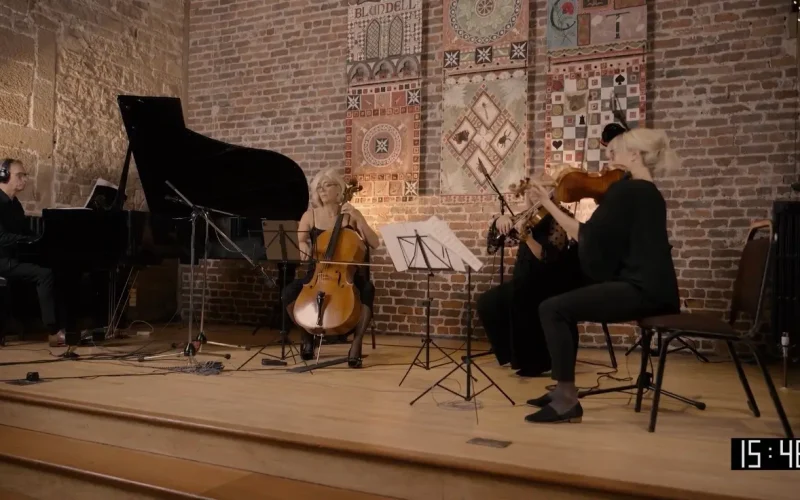
- We need to wake up – teaser videoMusicians from the Liverpool Philharmonic Orchestra as well as leading voices from across the world create a powerful video to create a movement to end postpartum haemorrhage (PPH) which claims a woman’s life every 12minutes
- With contributions from the leading voices in maternal health from across the world: Professor Jacqueline Duncley-Bent Chief Midwife, International Confederation of Midwives (ICM), Dr Femi Oladapo, Head, Maternal and Perinatal Health Unit, World Health Organisation, Professor Anne Kihara, Former President, International Federation of Gynecology and Obstetrics (FIGO) 2023-5, Professor Andrew Weeks, University of Liverpool.
A powerful Liverpool-made film inspired by a specially commissioned musical composition will receive its world premiere on World Postpartum Haemorrhage Day (Monday 5 October), helping shine a spotlight on the leading cause of maternal death worldwide.
The film, created in Liverpool and featuring a specially commissioned score by composer John McHugh, brings together music, testimony and visual storytelling to highlight the devastating impact of severe bleeding during or after childbirth.
Despite advances in healthcare, around 44,000 women die every year from obstetric haemorrhage, many of those deaths preventable.
The work will be premiered globally by leading maternal health organisations including the International Federation of Gynecology and Obstetrics (FIGO), the International Confederation of Midwives (ICM), the Royal College of Obstetricians and Gynaecologists (RCOG) and the World Health Organization (WHO) as part of World Postpartum Haemorrhage Day 2026.
The film was inspired by the internationally recognised Blood Clock installation at the Liverpool Medical Institution, created by Dr Graham Tydeman. Built largely from discarded medical equipment, the installation serves as a stark reminder of the women who continue to die from severe bleeding during and after childbirth. Every six minutes a flask fills and tips, symbolising another life lost.
Liverpool composer John McHugh interviewed some of the world’s most respected obstetricians, midwives and maternal health experts before transforming their words, emotions and experiences into music. Musicians were filmed performing at Crosby Hall as part of the production.
One message emerged repeatedly throughout the interviews:
“We need to wake up.”
For McHugh, those words became a central musical theme, developing throughout the composition as a call to awareness, action and hope.
Professor Andrew Weeks, University of Liverpool obstetrician and one of the world’s leading voices in maternal health, said:
“Both the film and the day is about remembering those who have died, celebrating the progress that has been made and inspiring action to ensure many more survive in the future.”
Professor Jacqueline Dunkley-Bent, Chief Midwife at the International Confederation of Midwives, said:
“Numbers obscure the human experience. There’s a person behind every death. There’s somebody’s aunt, somebody’s sister, somebody’s daughter, somebody’s wife, somebody’s mother.”
The project highlights Liverpool’s unique contribution to medicine, public health and innovation. Home to one of the world’s oldest medical institutions and a city renowned internationally for its role in medical discovery, tropical medicine and public health, Liverpool is helping lead a global conversation on maternal survival through the power of culture and the arts.
Organisers hope the film will encourage greater awareness of postpartum haemorrhage while demonstrating how music and creativity can help communicate complex health challenges to wider audiences.
QUOTES FROM THE FILM
Prof Jacqueline Duncley-Bent Chief Midwife, International Confederation of Midwives (ICM)
In some parts of the world, women do not die from postpartum hemorrhage. On the whole, it is preventable. However, in some countries, particularly sub-Saharan Africa, countries in the global South, there are many challenges that mean that midwives, obstetricians, gynecologists who are supporting women around the time of birth haven’t got the appropriate infrastructure to be able to stop preventable death.
Dr Femi Oladapo, Head, Maternal and Perinatal Health Unit, World Health Organisation
Postpartum haemorrhage is kind of buried under several other things, what we call maternal health, and andthe politicians and the parliamentarians and policymakers who take decisions for all of us to not really identify it as a problem. They sometimes know that women die from something, but it is not like HIV or malaria or hepatitis or COVID, for instance, which everybody was, oh yeah, you know, we need to do something about this.
So we need to elevate what it really means, you know, that the catastrophe that could happen within minutes if something is not done to save the woman’s life.
First of all, it’s going to elevate the urgency around postpartum hemorrhage to the entire world. But most importantly, the politicians, the parliamentarians, they need to know that there’s an entity or there’s a condition that is called postpartum haemorrhage, which is the leading causes of maternal death worldwide.
Prof Anne Kihara, Former President, International Federation of Gynecology and Obstetrics (FIGO) 2023-5.
We need to value women. We need to make sure every woman who carries a pregnancy ends that pregnancy healthy. Mamas are having pregnancies in precarious situations, economic downturn, lack of education, poverty, malnutrition, wars and conflict. Can we recognise they’re there? Can we remember they are there? Can we do something to make it a safer passage, we shouldn’t today have to be raising awareness about preventable death from postpartum hemorrhage. This should be a thing of the past.